
In our 3rd quarter portfolio commentary, we touched briefly on market concentration and how it might be skewing index performance, particularly in the US. As mentioned, the dominance of a small group of names in the S&P 500 is undeniably linked to the very strong earnings growth being posted by companies participating in the AI infrastructure build-out, but it’s also being compounded by the persistent growth of passive investing. While programmatic buying of index funds by 401K, RRSP, and other accounts has provided a nearly “relentless bid” beneath stocks, it has also meant that the largest companies in the market have received the most investor capital. This is because the world’s most important benchmark is “market cap” weighted instead of equal weighted, meaning that giant companies like Nvidia receive billions more in passive investment dollars each quarter than, say, food maker Kraft Heinz or industrial bellwethers like 3M and Honeywell. This unique backdrop has created a top-heavy market, in which the S&P’s top 5 companies now account for more than 30% of its value, whereas just a decade ago the 5 largest stocks made up only about 12% of the benchmark. The other potentially worrisome aspect of this structure is that the firms in the market’s upper echelon are all what one might describe as “new economy” businesses, with several directly exposed to AI development. This narrow focus is also amplified by the record representation of stocks on household balance sheets and by the trend toward investing with borrowed funds, which has pushed margin balances as a percentage of market value to all-time highs.
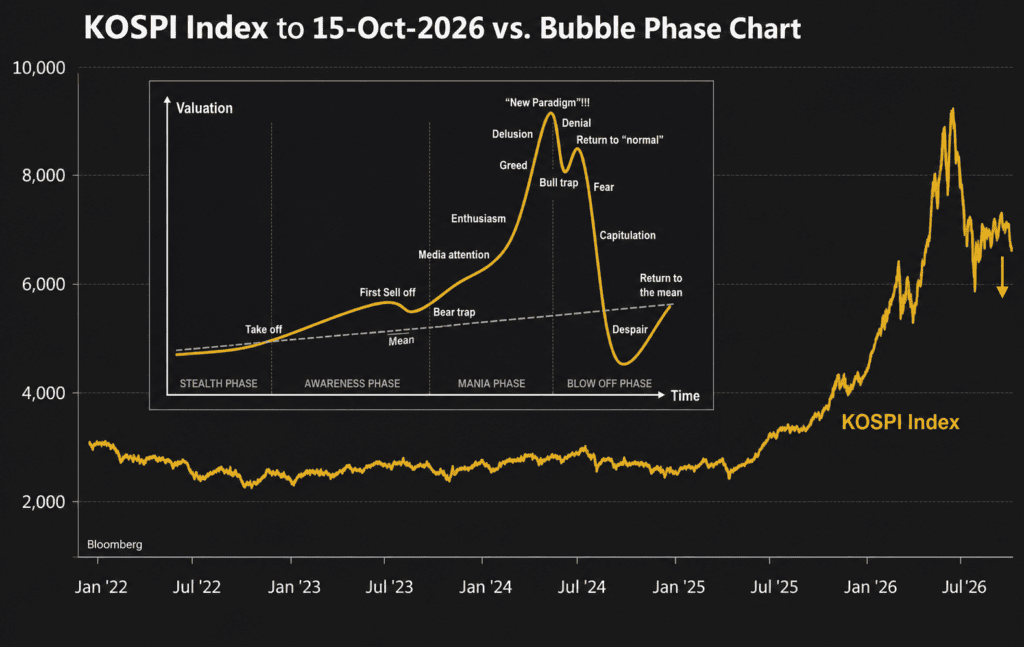
Korea’s KOSPI Index recently provided a glimpse into what can happen when a tightly focused trade unwinds. That market is even more concentrated than the S&P, with two stocks – Samsung Electronics and microchip maker SK Hynix – accounting for more than 50% of value, so when tech stocks pulled back in mid-October, the highly exposed KOSPI plunged by more than 20% in a week. Below we’ve compared a diagram created by professor Jean-Paul Rodrique to describe the typical inflation/bursting of an investment bubble with the KOSPI’s recent path. While bubbles can only be truly identified in hindsight, it’s nonetheless notable how well the tech-heavy Korean market’s pattern fits with Dr. Rodrique’s road map.
Portfolio Activity
In September, we trimmed our allocation to Microsoft in DM US Equity and left resulting proceeds in cash. In DM Canadian Equity, we reduced our weights in TD Bank and TFI International and sold our position in Thomson-Reuters Corp. We also increased our target allocation to DM International Equity by 5% and rebalanced portfolios toward bonds, where appropriate.
Feature Stock
Descartes Systems Group (DSG)
DSG is a Canadian multinational technology company specializing in logistics software, supply chain management software, and cloud based services for logistics businesses. In early October, the company used its Innovation Forum in Chicago to unveil the Descartes Agent Control Plane (ACP), an AI-driven orchestration layer built on its global logistics network to coordinate multi-step workflows across applications under defined policies and human oversight. DSG showed the power of the ACP by tracing an 11,000 mile supply chain from a factory in Vietnam to delivery in the US, which involved 28 steps, four company personas, and 15 DSG products. Its agents can read and extract relevant logistics data from a client’s email inbox, reach out to third parties to request missing documents, and connect with drivers to request status updates. By embedding AI agents directly into logistics processes while enforcing customer-defined guardrails and full traceability, DSG is aiming to make automation more trustworthy for supply chain operators who need faster responses without giving up control. DSG shares have gained more than 20% since the beginning of the summer.