
Bond bombshell
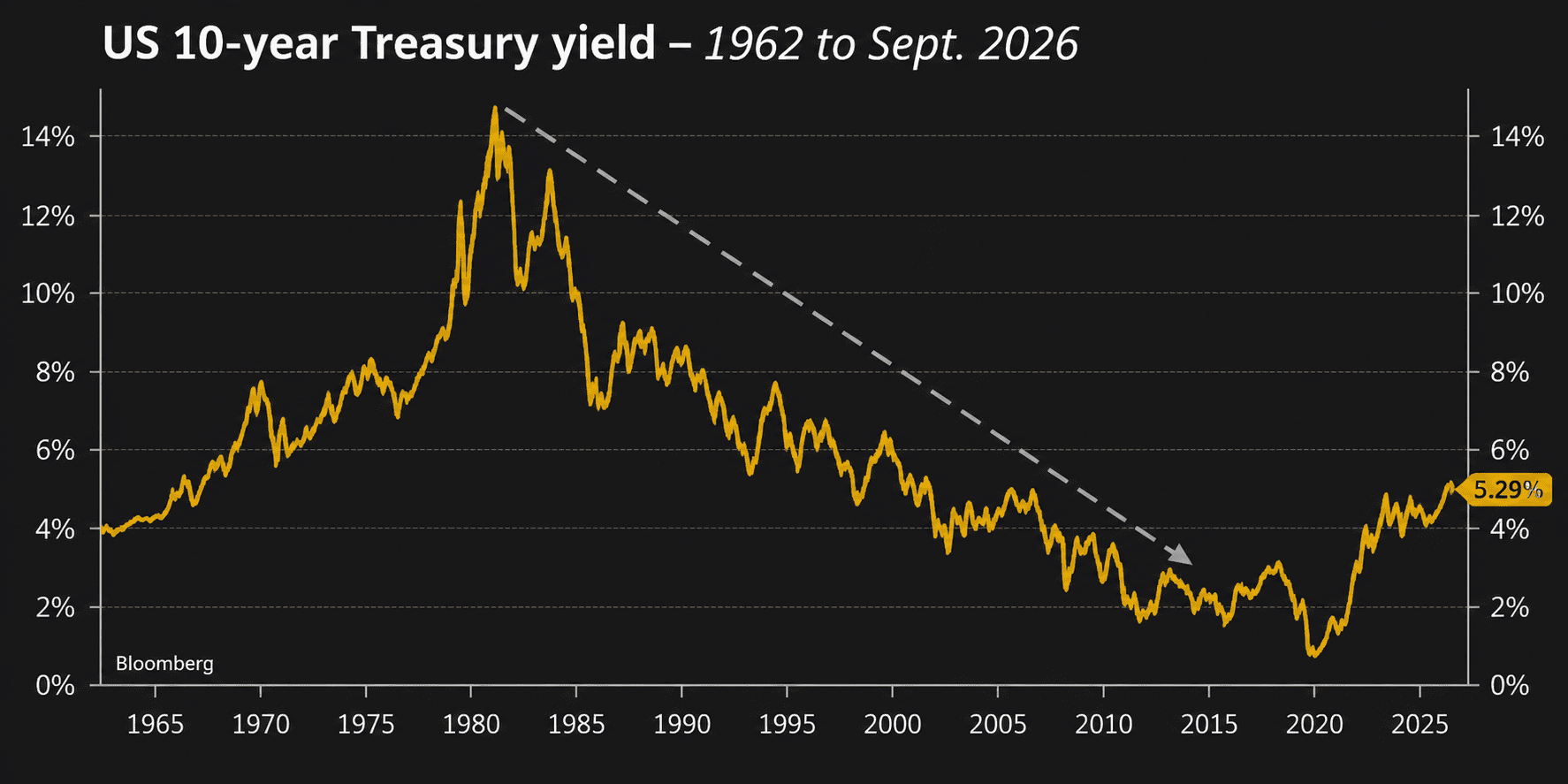
The vast majority of people in the investment business (all current DM staff included) have only worked in an environment of falling interest rates. Yes, there were interim reversals in this progression and periods where central bankers were temporarily tightening against the grain but, by and large, we’ve all invested against a backdrop where the cost of money was dwindling and competition for investment capital was meagre. Based on the preponderance of recent evidence, it seems very likely that this tailwind has reached its end.
In Q3, the US 10-year treasury yield broke decisively through 5%, while posting its biggest quarterly increase in more than three decades, and the US Federal Reserve boosted its policy rate for the first time since it was hiking to contain the post-covid inflation spike. Rising interest rates have a direct effect on the real economy, lifting consumer costs for everything from mortgages to car loans, and increasing the burden on businesses with debt rolling over and those that may wish to borrow to fund growth, acquisitions, or share buybacks.
Higher bond yields also carry implications for stocks by providing a more viable alternative for investor capital and raising the rate at which future cash flows are discounted back to present value. Though earnings strength has allowed public markets to largely take the recent yield spike in stride, our investment team is acutely aware that a new rate regime could not only pressure profit growth going forward, but will also impact how that income is valued.
How did we get here?
Rate rises can often be attributed to the expectation of higher future growth, with the bond market looking ahead to a time when elevated economic activity might also produce inflation, which would require a tightening response from policy makers. Though growth is modest at the moment, some are predicting that the widespread adoption of artificial intelligence will lead to both a productivity boom and a significant economic liftoff. While this may occur, the other half of that premise – that workers will be replaced by technology – should be disinflationary in nature which would imply lower, not higher, bond yields.
Of course, in the here and now, inflation has reawakened just as central bankers were growing content that they had slayed that pandemic by-product (as one observer put it, “the Fed was done with inflation, but inflation wasn’t done with the Fed”). Regrettably, virtually every major policy instinct of the current US administration has put upward pressure on consumer prices. Tariffs? Costlier imported goods. Deportations? Less cheap labour. War? Not much needs to be said about what the Middle East imbroglio has done to energy prices and especially to diesel, the economy’s cornerstone fuel.
Another possible explanation for the rise in rates is a collective revolt against the rapid and now self-feeding growth of government debt. Net interest cost recently passed Defense, Health, and Medicare to become the second largest expense in the US budget and, if rates continue on their current path, it won’t be long before it’s challenging Social Security for top spot. This unproductive drag will only be exacerbated by a deficit that is expected to grow by more than 10% in 2026.
While the US government will never directly default on its debt, it can certainly undermine the dollar’s value by creating money to meet its obligations and so it’s not unfathomable that the bond market is requiring extra compensation for this possibility. A clue as to whether this might be occurring can be found in the “real rate” of interest, or the difference between headline bond yields and the rate of inflation. While the real yield on the 10-year US Treasury Bond was below 2% last May, it is now nearly 3%, indicating that the market is requiring more compensation for holding a US government obligation. While this could be a reflection of heightened expectations for economic growth, it could also indicate a greater need for risk compensation. Incidentally, the last time the real yield hit 3% was in October 2008 when the world was rightly concerned about the viability of the entire global financial system.

There has to be an AI angle, right?
Of course there is! As it turns out, hyperscalers and other infrastructure players scrambling to build out the artificial intelligence ecosystem have become the government’s greatest competitors for debt capital. Initially, most AI capital expenditure was covered by the internal cash flow of the tech giants, but the size of investment has now fully swallowed this source, making it necessary for them to borrow hundreds of billions of additional dollars..
In June, JPMorgan Chase estimated that $4.1 trillion in AI-related debt will be issued through 2030, as participants look to complete data centres and ramp up compute capacity. As many would have learned in Economics 101, when the demand for something rises, so does its price and in this case, the unprecedented appetite for borrowing is undoubtedly helping to push up the cost of money.
With treasury yields now at their highest level in 25 years, the financing burden for AI builders is suddenly much more onerous than what might have been pencilled just a few months ago. And while the “hyperscaler” group of companies doesn’t generally have to pay a large risk premium on the debt they issue, this isn’t true of second and third tier players from whom the market is now demanding substantial compensation. In a recent report, bond rating agency Moody’s said, “We have growing concerns about the $3.5 trillion of hyperscaler liabilities about to hit balance sheets (and $2.5 trillion with Anthropic and OpenAi), and the circular nature of revenue and deals”, while Standard & Poors noted, “Every time we take a deep dive into this sector, we find that capex is rising faster than we anticipated, financings are becoming more complicated and less transparent, and that returns on investment will take years to realize.” Perhaps not surprisingly, some recent AI debt deals have required yields in the double-digit range to attract investors – though much has been made about the power generation bottleneck being faced by AI, its first big speedbump might turn out to be the cost of financing its development and implemen-tation.

What about stocks?
Both the TSX and S&P 500 ended September just below all-time record levels. As mentioned, earnings growth in the US has been strong enough to overcome the pressure of higher interest rates, while the TSX has benefitted from its relative overweight in commodity producers. Third quarter returns were concentrated in both countries, with only three of ten sectors posting gains in Canada, and the US market continuing to be driven by a very small number of AI and AI adjacent names. In fact, even though the S&P 500 rose by more than 2% in the quarter, 76% of its members fell during the interval and, according to Citadel Securities, while Microsoft, Nvidia, Apple and Meta added 300 points to the benchmark in Q3, the other 496 stocks collectively cost the index 150 points.
As shown in the chart above, technology and tech related stocks are dominating the market to a greater degree than ever before, with cyclical (energy, financials, industrials, materials) and defensive (healthcare, consumer staples, utilities) sectors essentially shunned by investors. This condition is undoubtedly exacerbated by the relentless surge in passive investing, where capital pouring into index units mechanically buys more and more of the weightiest stocks in the benchmark. In some ways, the vehicle that was intended to provide investors with the greatest possible diversification has instead morphed into a very concentrated, risk-on bet.
Taking all of this into account, we continue to broaden diversification in our equity mandates and reduce exposure to areas which we feel might be at risk. In Canada, this has meant trimming our allocation to the banking sector on valuation and credit concerns and adding to the diversified energy space, which should benefit from both strong commodity prices and Prime Minister Carney’s nation-building agenda.
In the US, we sold our entire position in Meta in the opening days of Q4 after the stock had rallied sharply following the release of its Muse AI agent and in September, we trimmed profit from Microsoft. So far, we’ve left this capital in cash but will likely redeploy it soon into some of the names that have been left behind in the rush to technology. With bond yields at long-term highs and finally offering a reasonable contribution to portfolio return, we’ve also begun to rebalance portfolios that contain fixed income allocations. If you’d like to discuss this opportunity or any of the points raised above, don’t hesitate to reach out to your DM advisor.